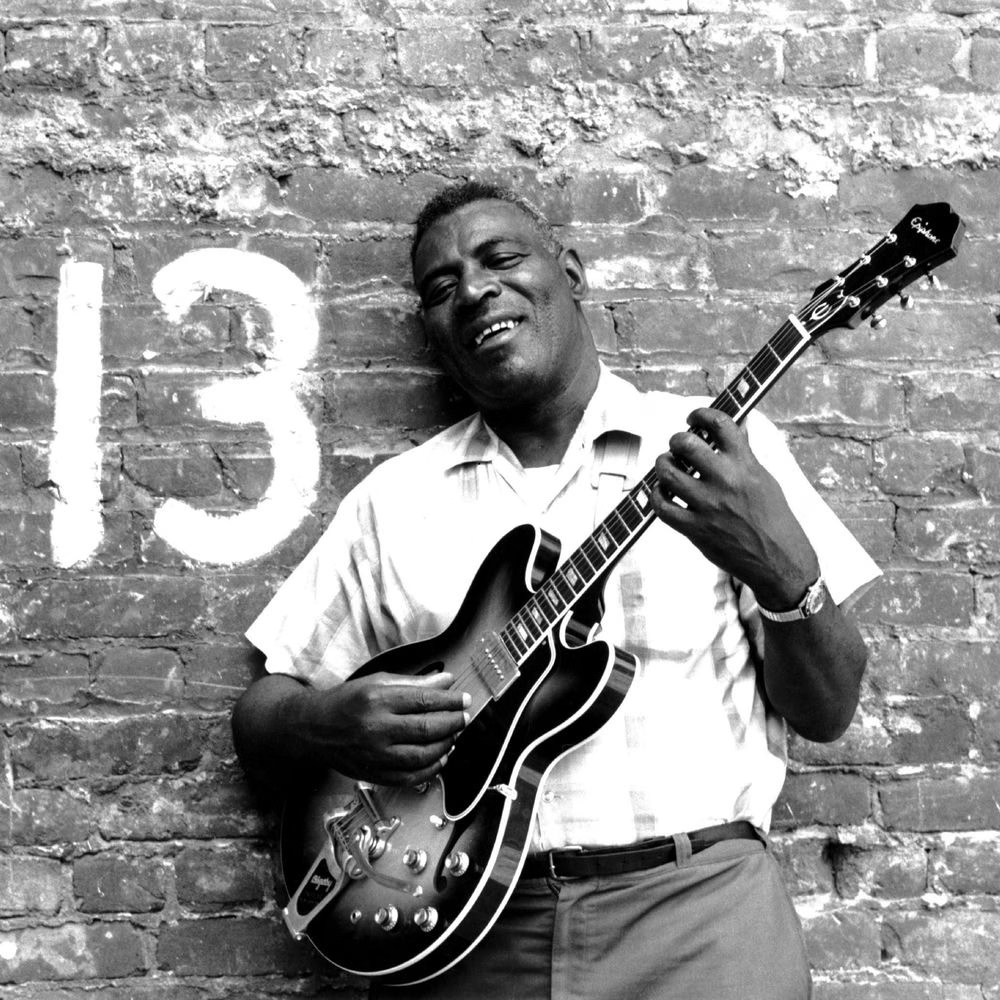
I have seen grown men step back when the Wolf opened his mouth. I have seen rooms change temperature. Chester Arthur Burnett, born June 10, 1910 in White Station, Mississippi, was six foot three and weighed close to three hundred pounds.
He could play guitar and harp and he could sing like he was trying to reach the back row of creation. I call him the Wolf because that is what he answered to, that is what he was. Not a metaphor. A fact. When he stepped to the microphone at the Chicago blues clubs, the floorboards knew they had been tested.
The Delta is where the Wolf got his start, learning the same Mississippi earth that gave us Charley Patton and Son House. He walked into a world where the blues was a trade and a testimony, where a Black man with a guitar was either a preacher or a devil and sometimes both. He served in the Army, worked as a farmer, and did not record until 1951 when Sam Phillips cut him in Memphis. Phillips said later that the Wolf was where the soul of man never dies. He was right. The cost came when the Wolf moved to Chicago in the early 1950s and found the electricity, the noise, the competition. He was a country man in a city of concrete and amplifiers. He made the amplifiers sound like country anyway. He wrestled Willie Dixon for control of his sessions, fought for his sound, and won. The Wolf did not lose fights.
"Smokestack Lightning" is not a song. It is a force of nature trapped in wax. That riff -- four notes bent and held and bent again -- is the simplest thing in the world and nobody has ever played it better. The Wolf's voice moves through the track like weather, howling the title phrase and then letting the guitar and harmonica answer.

The structure is a trance. There is no verse. There is no chorus. There is just the groove and the howl and the feeling that something ancient is happening in the room. The Wolf did not sing about trains. He became the train. He did not sing about the blues. He was the blues walking around in a suit. Hubert Sumlin's guitar slashes through the track like lightning itself, and you understand why the record labels could not explain it. You do not explain storms. You testify to them.
The Wolf died January 10, 1976, but I tell you the howl has not stopped. You hear it in every guitar player who bends a string like they mean it, every singer who opens their throat and lets the whole history come through. The Rolling Stones took his name and his music and carried it to white audiences. The real work was done in those Chicago clubs, in those Chess Records sessions, in the sweat of a big man who learned the blues in the Mississippi dirt and brought it to the city and made the city bow. Howlin' Wolf was not a style. He was a source. And the source does not run dry. Hallelujah.