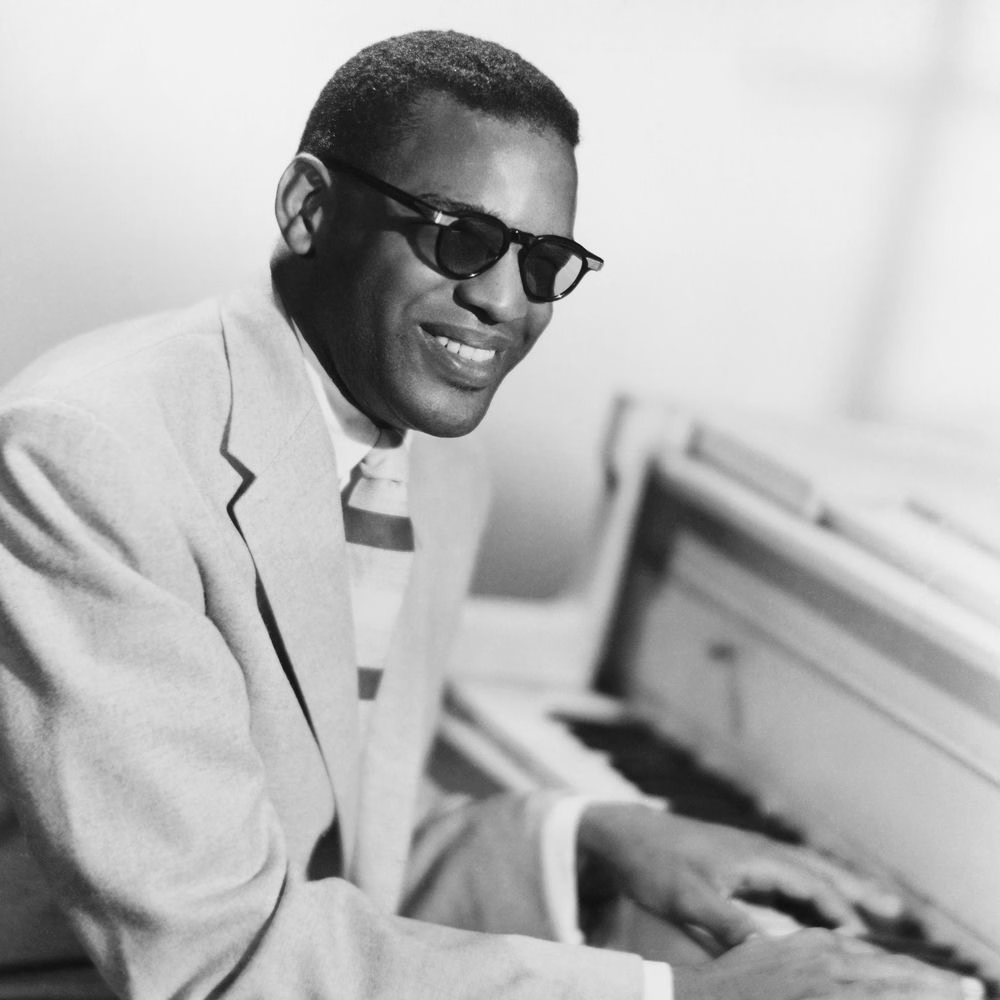
He was blind by seven and orphaned by fifteen. He learned to read Braille music, to play piano, saxophone, clarinet, and trumpet, and to arrange for a big band -- all before he was old enough to vote. The state of Florida sent him to the school for the deaf and blind in St.
Augustine, which was segregated, underfunded, and the best thing that ever happened to him. He left at fifteen after his mother died, and he hitchhiked across the country to Seattle, where he formed a trio and started playing the Nat King Cole songbook so convincingly that people thought they were hearing the records. He was good. He knew he was good. What he hadn't figured out yet was how to sound like himself.
The answer came at Atlantic Records. Ahmet Ertegun and Jerry Wexler signed him in 1952 and told him to stop imitating Nat Cole and Charles Brown. Find your own voice. Ray found it by doing the most dangerous thing a Black musician could do in 1954: he took gospel music -- the call-and-response, the ecstatic shouting, the sanctified fervor of the Black church -- and put it in a juke joint. I Got a Woman. Hallelujah I Love Her So 0:30. What'd I Say 0:30. The church was furious. The juke joint was never the same. The call-and-response on What'd I Say, with the Raelettes answering his moans and groans, was so sexually explicit that some radio stations banned it. It went to number one on the r&b chart anyway. Sacred and profane, Ray proved, had been the same thing all along.
Then he did something even more audacious. In 1962, at the height of the Civil Rights Movement, a blind Black man from Georgia walked into a Nashville studio and recorded Modern Sounds in Country and Western Music -- an album of country standards rearranged with string sections and a big band. I Can't Stop Loving You. You Don't Know Me.

Born to Lose. It topped the Billboard 200 for 14 weeks. A Black man singing white working-class music to a segregated nation, and the nation couldn't stop listening. Ray Charles didn't recognize musical boundaries any more than he recognized racial ones. He played what he felt, and he felt everything.
The heroin took decades. He was arrested multiple times, finally kicking the habit in 1965 after a court order. The voice got rougher, deeper, more lived-in. He recorded with country stars, with symphony orchestras, with whatever musicians walked through the door. He did a Pepsi commercial. He appeared in The Blues Brothers. He won 17 Grammys and the Presidential Medal of Freedom. The last album, Genius Loves Company, was released two months after his death from liver disease. It won eight Grammys, including Album of the Year. Brother Ray had been saying it for 50 years: there's only two kinds of music -- good and bad. He played the good kind.
Ray Charles was profiled in the documentary, Ray, in 2004.