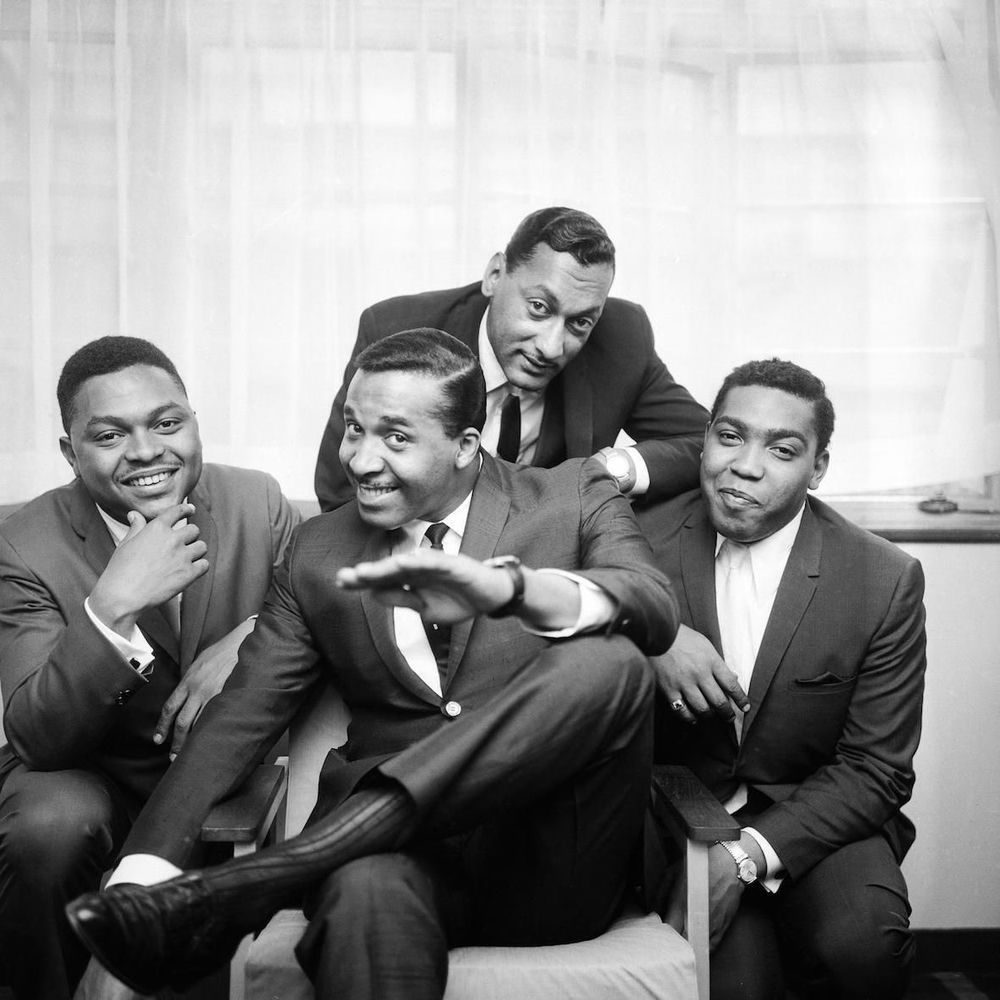
The four men on stage didn't dance. They stood in a semicircle, took turns stepping forward, and let their voices do the moving. It looked like a church formation, four believers who knew the arrangement better than the songwriters who wrote it.
And when Levi Stubbs opened his mouth, the sound that came out was not a tenor or a baritone -- it was a force of nature, a roar that could strip paint and break glass and still hit every note dead center. The other three voices wrapped around him like support beams, holding up a sound that was too big for any one man to carry alone.
Formed in Detroit, Michigan in 1953, The Four Tops were veterans by the time Motown found them. Levi Stubbs, Abdul "Duke" Fakir, Renaldo "Obie" Benson, and Lawrence Payton had been singing together for over a decade, perfecting a harmony blend that required no choreography because the music itself was the show. When they signed with Motown in 1963, they were assigned to the songwriting team of Holland-Dozier-Holland, and the combination proved to be one of the most productive partnerships in pop history. The Tops gave the songs a gravitas that the writers didn't know they had written, transforming pop craftsmanship into something that felt like gospel testimony. The voice was the instrument, and the instrument was unmatched.
"Reach Out I'll Be There 0:30*" was the peak of the partnership, a 1966 single that hit number one on both the pop and R&B charts. The song opens with a tambourine and a bassline that sound like an SOS signal, and then Stubbs enters with a vocal that goes from plea to demand to declaration in the space of a single verse. The production was maximalist -- strings, flutes, backup voices, a drum fill that keeps threatening to take off without the rest of the band -- but Stubbs's voice held it all together, a center of gravity that nothing could break. "I Can't Help Myself 0:30* (Sugar Pie, Honey Bunch)" had already proven the formula: Holland-Dozier-Holland wrote the architecture, and The Four Tops occupied it like the building was built for them.

The chemistry was unstoppable and the hits kept coming.
Still active after Levi Stubbs's death, with Duke Fakir carrying the torch, The Four Tops defined the Motown vocal group sound at its most mature. Every group that relies on vocal power instead of stage moves, every singer who understands that the voice is the only instrument that matters, every fan who knows that "Reach Out" is devotion carved into four minutes of vinyl -- they're all answering that same SOS. The Tops didn't need to dance. They had already earned the right to stand still.