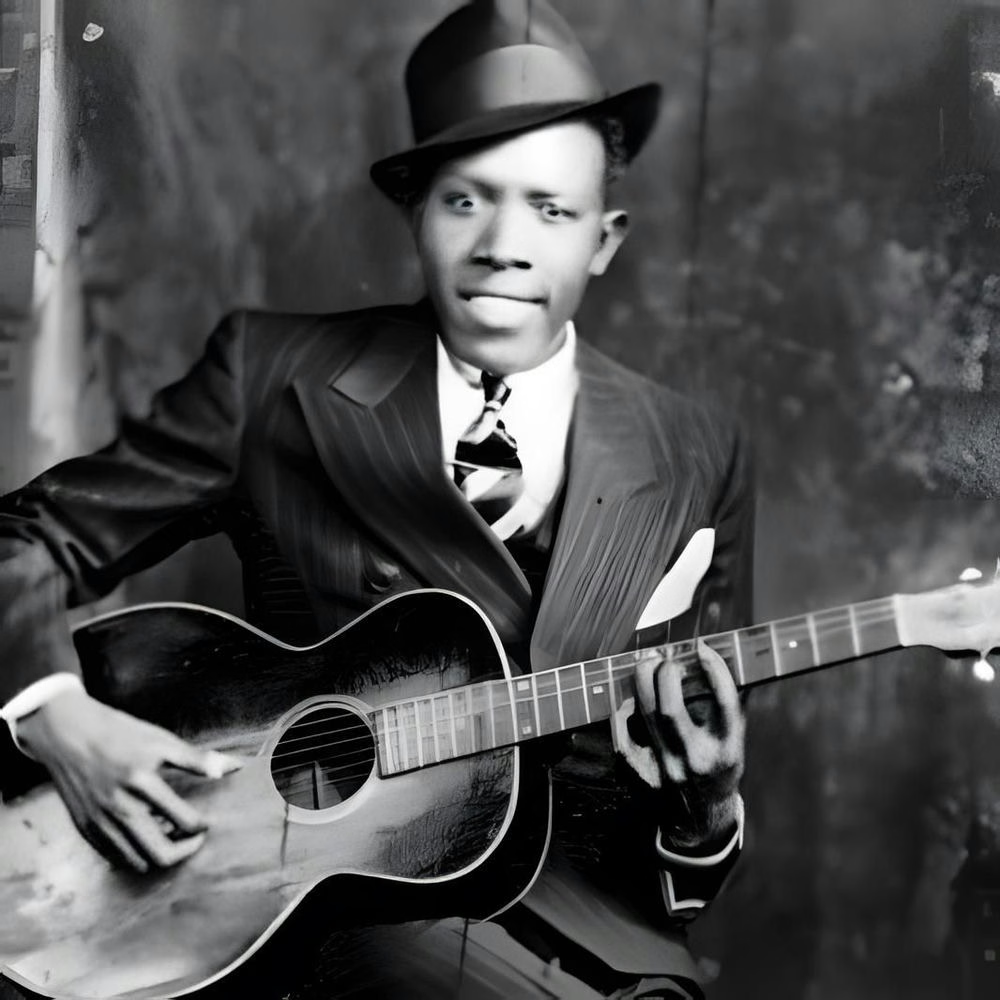
Twenty-nine songs. That's the whole catalogue. Twenty-nine tracks cut in a San Antonio hotel room and a Dallas warehouse in 1936 and 1937, and every single one of them sounds like a man who knew he wasn't staying long.
The recordings are scratchy in the way 78rpm shellac is scratchy, but the music underneath -- that sliding, spectral guitar, that high keening voice that sounds like it's coming from somewhere underneath the floorboards -- is as vivid as anything recorded since. Robert Johnson didn't invent the Delta blues, but he distilled it into something so potent that the mythology swallowed the man whole. The crossroads story -- sold his soul to the devil at midnight for the guitar -- is probably not true. But it stuck because the music made it believable. Nobody played like that.
He was born in Hazlehurst, Mississippi, the eleventh child of Julia Major Dodds, whose husband Charles Dodds had been run out of town by a lynch mob years earlier. Robert was illegitimate, shuffled between households, partly blind in one eye from a cataract. He married Virginia Travis at 17. She died in childbirth within the year. He took up the guitar in earnest after that, following the juke joint circuit, watching the older players -- Son House, Charley Patton, Willie Brown -- and then disappearing for months at a time. When he came back, the other musicians couldn't believe what they were hearing. House said he must have sold his soul. Johnson didn't correct him.
The recordings are the evidence. Terraplane Blues was his only hit during his lifetime -- a car metaphor for sex that sold a few thousand copies. But the rest: Hellhound on My Trail, with its keening falsetto and that descending bass figure that sounds like footsteps following you. Come On In My Kitchen, a song about betrayal that feels like a weather report from somewhere very cold.

Love in Vain, which he recorded in the last session before his death, a song so complete in its despair that the Rolling Stones couldn't improve it 30 years later. The guitar style was the revelation: a walking bass line played with the thumb, a melody on the treble strings, and a slide that sounded like a human voice breaking. He played in open tunings, capoed up the neck, and the result was a sound so full it didn't need a band. One man, one guitar, and the whole Delta in the room.
He died at 27 -- poisoned, or stabbed, or both, at a juke joint outside Greenwood, Mississippi. The details depend on which account you believe. The jealous husband story is the most popular: Johnson had been fooling around with the proprietor's wife, and the man slipped strychnine into his whiskey. Johnson crawled on all fours, howling like a dog, and died three days later. His death certificate, if there is one, has never been found. The man who played like a ghost became one on the terms he'd always known -- violent, sudden, and mythic.
What happened next is the part nobody could have predicted. In 1961, Columbia Records released King of the Delta Blues Singers, a compilation of Johnson's 78s, and it landed like a bomb in the middle of the British folk revival. Keith Richards heard it and had to relearn how to tune his guitar. Eric Clapton heard it and spent the next 40 years chasing that sound. Bob Dylan said Johnson's lyrics were "the most powerful words I'd ever heard." The kid from Hazlehurst who couldn't hold an audience in a juke joint became the ghost that launched a thousand bands. Twenty-nine songs. That's what he left. The 30th is the one we'll never hear.
Robert Johnson was profiled in the documentary, The Search for Robert Johnson, in 1992.